


Climategate be gone: Climate scientists cleared of malpractice
May 5, 2010
Remember Climategate? Well, the University of East Anglia’s Climate Research Unit, which was the target of climate-deniers wrath, has cleared of “any deliberate scientific malpractice,” and had a panel declare their methodology sound.
From Bad Astronomer Phil Plait:
As a backstory, you may wish to read two earlier posts I wrote on this topic, the first introducing climategate, and a second following up to clarify some points. Basically, some emails from climate scientists were leaked by a still-unknown hacker, and to some people it indicated knowingly fraudulent activity by the scientists. However, those of us familiar with the way science and scientists actually work knew from the start there was nothing nefarious going on.
When the emails were made public, a lot of noise came from the usual places. The deniers went into overdrive. But it turns out they were just spinning their wheels. This is the second investigation to show nothing bad was going on; the first was from a Parliamentary committee which also cleared the scientists of any wrongdoing.
So now we have a panel of politicians as well as a panel of scientists, both of whom have concluded that the CRU scientists are honest. Kinda makes you wonder where Inhofe and Cuccinelli are going, doesn’t it? …
… The bottom line: the climate scientists at East Anglia’s Climate Research Unit worked honestly, and their results are robust.
And one final thing: I challenge the mainstream media to give this even a fraction of the attention they gave to the story when it broke. I won’t hold my breath.
So much gloating and chest-thumping from climate deniers, evaporates in puff of scientific theory. Of course, like any conspiracy theorists (which climate deniers are), they’ll find some other ineffective and untrue ways to try and debunk the findings of thousands and thousands of scientists and their remarkable amounts of scientific data. It’s what conspiracy theorists do, after all.
-WKW
NASA on Humans & Climate Change
May 5, 2010
From NASA’s Earth Observatory, a detailed look at why the vast majority of scientific minds on the planet believe that climate change is a result of human activity.
A snippet:
Finally, scientists know that carbon dioxide is a greenhouse gas and that it is released into the air when coal and other fossil fuels burn. Paleoclimate data show that atmospheric carbon dioxide levels are higher than they have been in the past 800,000 years. There is no plausible explanation for why such high levels of carbon dioxide would not cause the planet to warm.
I wouldn’t expect that climate-change deniers will change their minds due to NASA, of course. It’s not like they’re rocket scientists or anything.
-WKW
It’s hot in Brazil - thus proving Global Warming
February 10, 2010
BRAZIL - After temperatures soared to more than 100 degrees Fahrenheit today in both Sao Paulo and Rio De Janeiro, Brazil, a group of scientists working on a comprehensive study stated that Global Warming has now been proved, and no further testing or data is required on the subject.
“Our group went outside and felt extremely warm,” said noted climate Scientist John Timson. “This confirms all our beliefs. Global Warming is a fact.”
The scientists had gathered in the Copacabana barrio of Brazil. In order to collect data, the group spent two hours at the beach, and occasionally went into the ocean. The scientists reports states that the water was “noticeably cooler that the outside air.” Following a bite to eat at a Brazilian barbecue, the scientists stated they had enough data to advance Global Warming from a Theory to a Law.
“It was really hot out there. I mean scorching,” said Timson. “Let there be no doubt that Global Warming is now a Law. Like gravity.”
A reporter for a major American newspaper asked how they could be so sure that Global Warming was now indeed an indisputable fact, being that many parts of the U.S. are going through a cold spell with large amounts of snow. Timson scoffed at the question.
“Of course it’s cold in the U.S., you idiot,” said Timson. “It’s winter there.”
-WKW
Famous last words
September 4, 2009
When the last living thing
Has died on account of us …
To be used for killing, money is no object. For healing, it is a valuable commodity and we must be frugal. The narcissistic and greedy who painted war’s dead out of the picture have already done their job of removing the sick from health care reform. The profit of the moment far outweighs forward thinking, and so we discuss genocide and history’s greatest monsters. And another claim is denied.
…How poetical it would be
If Earth could say,
In a voice floating up
Perhaps
From the floor
Of the Grand Canyon …
We will all sacrifice in order to maintain the status quo. We’ll continue paying to keep the rich comfortable and worry free. We’ll continue paying to kill, torture, rape and maim the nameless and faceless in far-off countries. And we’ll continue to put profit ahead of the planet. And as life is rinsed from the Earth, we’ll continually fight over the bounty of our own invention.
Until the final one, the possessor of all the world’s riches and wealth, is washed away. Like the rest of us.
… “It is done.
People did not like it here.”
-WKW
Sarah Palin: Champion of Global Warming
April 15, 2009
Climate change skeptics lost one of their own yesterday, as Sarah Palin is now firmly on board the global warming bandwagon. Apparently, after publicly squabbling with Levi Johnston and nominating and nominating a misogynist douchebag for Alaska Attorney General, she saw the light:
We Alaskans are living with the changes that you are observing in Washington,” she said. “The dramatic decreases in the extent of summer sea ice, increased coastal erosion, melting of permafrost, decrease in alpine glaciers and overall ecosystem changes are very real to us.”
In the past, Palin has questioned the science behind predictions of sea ice loss. Her administration sued the federal government to block endangered species protections for polar bears, whose habitat is melting. When she was the Republican vice presidential nominee in 2008, partisan crowds cheered her on by chanting, “Drill, baby, drill.”
But at Tuesday’s hearing, she made it clear that she recognizes the problem of global warming, and she cast energy development as part of the answer. “Stopping domestic energy production of preferred fuels does not solve the issues associated with global warming and threatened or endangered species, but it can make them worse,” she said.
Palin acknowledged that “many believe” a global effort to reduce greenhouse gases is needed.
“Simply waiting for low-carbon-emitting renewable capacity to be large enough will mean that it will be too late to meet the mitigation goals for reducing [carbon dioxide] that will be required under most credible climate-change models,” she warned.
In this world where even the weather is a partisan issue, science still doesn’t mean much to those on the right. But political necessity works every time. Welcome aboard, Sarah. For now.
-WKW
Washington Post reporters call out George Will on climate change lies - locusts and hellfire don’t destroy the joint
April 8, 2009
When journalists do well, they are to be applauded. From Grist.org:
Today, Washington Post reporters Juliet Eilperin and Mary Beth Sheridan have a piece on the alarming decline of Arctic sea ice. In and of itself the story isn’t that surprising: scientists have known for a while that the ice is declining; new data just confirms that it’s happening faster than originally estimated. That’s consistent with all sorts of new observational data on the effects of climate change, which across the board seem to be exceeding scientists’ most pessimistic predictions.
What jumped out at me is this bit, toward the bottom of the piece:
“The new evidence—including satellite data showing that the average multiyear wintertime sea ice cover in the Arctic in 2005 and 2006 was nine feet thick, a significant decline from the 1980s—contradicts data cited in widely circulated reports by Washington Post columnist George F. Will that sea ice in the Arctic has not significantly declined since 1979.”I can’t think of another instance when a news story at a newspaper explicitly called out an op-ed writer in the same paper for lying, by name. It’s pretty extraordinary. I can only imagine that something like this got passed up the editorial food chain, from science editor Nils Bruzelius to national news editor Kevin Merida, and perhaps beyond. (The Post will not talk on record about their editorial process; they “stand behind their reporting” and so forth.)
[UPDATE: After I put this post up, science editor Nils Bruzelius gave me a call and was quite collegial and open about the story. It was actually him who had the idea to reference Will, since the, ahem, “data” Will had distributed got so much publicity and was on people’s minds. He said he and the reporters agreed, it was a routine news judgment, nothing about it struck him as unusual, and as far as he knows no one above him questioned or was even aware of it. I don’t know how much of that is feingned innocence—I’ve certainly never heard of a similar case—but it seems there was no big process inside WaPo behind this. Cheers to Bruzelius for the transparency.]
If this sort of thing continues, it could force Will to ultimately use real facts in his opinion columns. Ok, it’s not likely, but possible. After all, they’re fairly hit-and-miss when it comes to facts over at the Post these days.
-WKW
Global Climate Change - we’ll deal with it when it’s over
March 13, 2009
Even with a much-more environmentally conscious President like Barack Obama, don’t expect much from the U.S. or China when it comes to fighting global warming. At least not until it’s already done all the damage it will do:
(CNN) — The world is facing an increasing risk of “irreversible” climate shifts because worst-case scenarios warned of two years ago are being realized, an international panel of scientists has warned.
Temperatures, sea levels, acid levels in oceans and ice sheets were already moving “beyond the patterns of natural variability within which our society and economy have developed and thrived,” scientists said in a report released Thursday.
The findings came at the end of a three-day conference in Copenhagen, Denmark, where nearly 2,000 researchers gathered to discuss climate change.
The group called on policy-makers to use all tools available to reduce dangerous emissions of greenhouse gases.
The current climate situation on the planet may be as severe as the worst-case scenarios predicted by the Intergovernmental Panel on Climate Change (IPCC), which issued warnings in 2007 of a future beset by flooding, drought, storms and mass extinction of species.
In its report, the researchers also warned of potential social costs across the planet because of climate change.
Whatever global climate changes are to bring, they will bring. And for a lot of folks living in high-risk areas, it will bring death. The Flat-Earthers amongst us will make sure of that.
-WKW
No one expects a blogaround XXXCCC
February 17, 2009
Former American Idol runner-up Justin Guarini is getting married. Our best wishes to the happy couple. In other news, former American Idol Justin Guarini shocked many when he managed to get into the news again for being engaged. In other news …
- Philosopher’s Playground: Even “positive stereotypes” aren’t positive.
- Notes from Evil Bender: A must-read for filmmakers - eight ways to redefine any film as a “Conservative movie.”
- Diane Tucker: How did so many reporters blow the story on the economic crisis? It’s probably your fault, obviously.
- Balloon Juice: No rest for the weary - now that the War on Christmas is over for now, the War on George Washington begins.
- Jonah Goldberg: Goldberg has “met innumerable writers and editors who are scared, even terrified, of one or more of these groups: gays, blacks, Latinos, Asians, Jews, feminists, evangelical Christians and the handicapped.” Really. Innumerable writers and editors. Somewhere Glenn Beck is nodding and crying.
- Jonathan Turley: Free Michael Phelps! Oh, never mind, no charges will be filed.
- America Blog: Global Warming worse than expected. To Conservatives, this means it’s all obviously a hoax created by Al Gore.
- Slactivist: On the bright side, 40 percent of Americans do believe in evolution.
-WKW
Watts Up With That? or: Why Internet Blogging Awards are meaningless
February 2, 2009
Receiving awards for one’s work is nice. I speak from experience, having won two prestigious Alaska Press Club Awards during my illustrious career. These awards have given my career and life a great boost, mostly due to the fact that I can now mention them repeatedly.
But let’s face it, any and all subjective awards are basically meaningless. And that could not be more true when it comes to awards for blogging. To solidify this point, one need only look at the 2008 Weblog Awards:
Best Science Blog: Watts Up with That?
Yes, according to 2008 Weblog Awards voters, a global warming denier has the best science blog.
From Wikipedia:
Watts has stated that he had “at one time been fully engaged in the belief that CO2 was indeed the root cause of the global warming problem” but “later changed my thinking when I learned more about the science involved and found it to be lacking.” He established the blog “Watts Up With That?” to popularise his views on global warming and the controversy around the science.
Watts expects that the result of the SurfaceStations.org effort will be “to demonstrate that some of the global warming increase is not from CO2 but from localized changes in the temperature-measurement environment” and has said “you have to wonder if the whole house of cards isn’t about to start falling down”.
When a pseudoscientist is given an award as a top science blogger, one must wonder if the whole Weblog Awards house of cards is about to start falling down. Because no matter how hard deniers try to prove it, the practice of scientific peer review has not utterly collapsed when it comes to climate change. And awarding those that think it has should tell you all you need to know about Watts up with the Weblog Awards.
-WKW
500,000 gallons of oil spilled due to Hurricane Ike - Remember that when Conservatives deny it
October 5, 2008
For the last couple of years, many prominent conservatives - led by John McCain - have used the talking point of “Not a drop of oil was spilled due to Hurricane Katrina.”
It’s a complete lie, of course. Katrina caused more than 100 oil spills.
These days, as conservatives have decided that giving oil companies the right to drill wherever they like will be the nation’s salvation, you can pretty much guarantee that they’ll start lying about the oil spilled into the Gulf of Mexico due to Hurricane Ike. But again, it will be a flat-out lie.
At Least 500,000 Gallons of Crude Oil Spilled Into Gulf Due to Hurricane Ike
WASHINGTON (AP) — Hurricane Ike’s winds and massive waves destroyed oil platforms, tossed storage tanks and punctured pipelines. The environmental damage only now is becoming apparent: At least a half million gallons of crude oil spilled into the Gulf of Mexico and the marshes, bayous and bays of Louisiana and Texas, according to an analysis of federal data by The Associated Press.
In the days before and after the deadly storm, companies and residents reported at least 448 releases of oil, gasoline and dozens of other substances into the air and water and onto the ground in Louisiana and Texas. The hardest hit places were industrial centers near Houston and Port Arthur, Texas, as well as oil production facilities off Louisiana’s coast, according to the AP’s analysis.
“We are dealing with a multitude of different types of pollution here … everything from diesel in the water to gasoline to things like household chemicals,” said Larry Chambers, a petty officer with the U.S. Coast Guard Command Center in Pasadena, Texas.
The Coast Guard, with the Environmental Protection Agency and state agencies, has responded to more than 3,000 pollution reports associated with the storm and its surge along the upper Texas coast. Most callers complain about abandoned propane tanks, paint cans and other hazardous materials containers turning up in marshes, backyards and other places.
Now, conservatives could always just be honest and say that they could care less about the environment. But they won’t. You watch, before the month is over, they’ll be gloating how Hurricane Ike didn’t cause a drop of oil to be spilled. And they’ll be right. It caused a half-million gallons of oil to be spilled.
-WKW
Dear Al Gore: You start with the Civil Disobedience and we’ll see how it goes
September 25, 2008
Despite a past disagreement, I believe David Swanson of “Let’s Try Democracy” is a decent guy who truly wants what’s best for the United States and the planet. But when he wrote tips on how to “make a citizen’s arrest of a war criminal” like Karl Rove or Donald Rumsfeld, I felt like he was missing one vital bit of advice - how to recover from the bullets that the “war criminal’s” security would surely put in your head if you touched them.
My feelings are the same in regard to Al Gore. He’s done a wonderful job of trying to get global warming information out to as many people as possible. But when he says things like: “It’s time for civil disobedience to stop the construction of new coal plants,” the former Vice-President needs to grasp reality a little better.
Mr. Gore, you start with the civil disobedience and we’ll see how that goes. A multi-millionaire defying authority sends a much stronger message than a bunch of poor people tying themselves to trees. The rest of us need to deal with things like consequences. And the U.S. is currently in position to deal out consequences in a pretty severe way.
-WKW
Hurricane Katrina caused 124 oil spills
July 21, 2008
The list of outright lies that Republican Bush followers are willing to spew has always been quite impressive. From gloating that the U.S. hasn’t had a terrorist attack since 9/11 to the relentless lies about warrantless eavesdropping, Bush’s attack crew has made it clear that even truthiness is too much of a challenge and that blatant lying is more effective. And their hyper-fringe base loves it.
These days, with gasoline prices on everyone’s mind, Republicans have pulled out at least two lies that they will repeat regardless how often they are called on them - that China is drilling for oil offshore of Cuba (they’re not) and that Hurricane Katrina didn’t cause any oil spills.
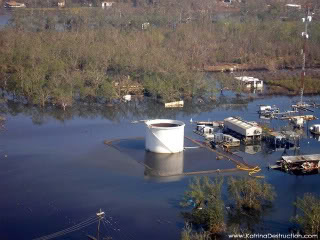
The second one is really the most egregious. Because Hurricane Katrina caused oil spills. More than 100 of them. Here’s a satellite picture of the Gulf Of Mexico after Katrina hit, courtesy of SkyTruth.org. See if you can see the oil.

Or here:
Are things better for you now than they were eight years ago? Is the Earth in better shape? Is the U.S. in better shape?
Radical Republican policies have made you poorer, less secure and less free> They have left the economy in shambles. They have destroyed the environment. They have made the United States a nation to be feared rather than respected.
And they will lie cheat and swindle to do whatever they can to avoid taking a speck of responsibility for any of it, and they will do all they can to rewrite recent history.
Don’t let them. Hurricane Katrina, and Rita before it caused oil spills. To say otherwise is a blatant lie. And real Americans just can’t afford to let those lies become public perception.
-WKW
Welcome to “Happy Feet” - reality edition
July 28, 2007

You know in the movie “Happy Feet” how the plucky penguin survives and manages to save the whole species? Well, here in the real world we drown penguins in oil as we rapidly work to kill them all off because the little buggers are just getting in the way of progress.
Hundreds of Oil-Covered Penguins Surface in South America
Hundreds of oil-covered Magellanic penguins have surfaced off the Atlantic coast of South America in the past few weeks, according to an animal welfare organization.
Magellanic penguins are medium-sized South American penguins. The species is classified as “near threatened” because of its vulnerability to oil spills, which kill tens of thousands of the animals yearly off the coast of Argentina.
Oil spills harm numerous types of marine life, including seabirds. Oil interferes with their waterproofing abilities. This forces penguins, which are birds, out of the frigid waters in a state of hypothermia, leading to dehydration and sometimes starvation.
A continuous stream of oil from spills has created a chronic problem across South American waters and other parts of the world, said Rodolfo Silva of the International Fund for Animal Welfare, one of the agencies helping to treat the penguins.
This week, 36 Magellanic penguins were being treated at the Society for the Conservation of Biodiversity in Maldonado (SOCOBIOMA) center in Uruguay, where more than 40 of the penguins surfaced.
“After being stabilized and fed, the washing process is in full motion right now, and we expect to be able to release them back to the ocean in about 15 days or so,” said Lourdes Casas of SOCOBIOMA.
-WKW
Galveston, Texas officials selling out their citizens and their past
July 24, 2007
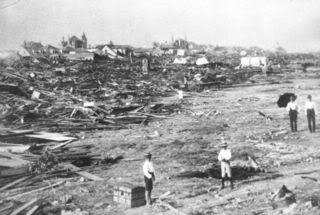
It is one thing to feel saddened by humanity’s lack of foresight when it comes to Global Warming. But when leaders ignore basic history in order to profit is when you start to realize that the term “blood money” no longer carries with it much stigma.
To wit: The Republican-led Galveston City Council will agree to allow a development which will sever the area’s sea wall, which was created more than 100 years ago following the worst natural disaster in U.S. history, in terms of lives lost.
Basically, the Council commissioned geologists to study the effect of the development on the area, then after not liking what the geologists had to say, ignored the report and will proceed anyway.
Critics: Galveston development goes against logic
The North Pole now a swimming hole
July 16, 2007
Shockingly, those intrepid reporters at the National Review - who only care about science, not ideology — seem to have missed this one.
19 mins, -1.8C: the first swim at the North Pole
Clad only in his Speedo trunks, cap and goggles as required by the rules of the Channel Swimming Association – which also forbid any buoyancy aids, swimming caps that offer any thermal protection or trunks cut above crotch level – Mr Pugh spent just under 19 agonising minutes in the melted sea ice navigating a path in a crack between broken floes.
The feat would not have been possible ten years ago, when the water was entirely frozen over, even in summer. …
Scientists predict that by 2040 the Arctic could be virtually free of ice in summer. Mr Pugh said yesterday that his achievement was a bittersweet victory. “It’s a triumph and a tragedy – a triumph that I could swim in such ferocious conditions, but a tragedy that it is now possible to swim at the North Pole.”
Don’t worry, though, I’m sure NRO can somehow spin this into a way to make Al Gore and Live Earth look bad. It’s what they do. At least when they are not cowering fearfully from Middle Eastern countries, tearfully begging their leader to drop more and bigger bombs on any ME nation not named Saudi Arabia.
-WKW
