


William K. Wolfrum’s Morning – It’ll blow your face off
August 10, 2010
Why blogging is better than spitting fire: My face almost never bursts into flames.
Census Bureau Returns Cash: Counting people isn’t as expensive as first anticipated.
Pentagon Cuts: Robert Gates wants some heavy cuts to the Pentagon budget. This could be war.
Alaska Crash: A plane goes down in Alaska, leaving 8 dead and friends worried that Ted Stevens was on the plane.
Damned Hippy Bloggers!: White House Press Secretary Robert Gibbs says the “Professional Left” won’t be happy until the Obama Administration institutes “Canadian healthcare” and “eliminated the Pentagon.” When asked, Gibbs can’t name anyone actually involved in the “Professional Left.”
People
Levi Johnston: The wacky neighbor of the Palin Show sitcom will be running for mayor of Wasilla in his new reality show. I don’t see the big deal. They’ve had worse candidates.
Dick Cheney: The Man Without a Pulse is now freely roaming the streets, hungrily devouring brains.
Blogs
Broadsheet: Jodie Fisher made soft-core porn more than a decade before accusing HP ex-boss Mark Hurd of sexual harassment. Let the slut-shaming begin.
Glenn Greenwald: Marriage and the role of the State.
NewsHoggers: Steven Slater says take this job and slide it.
Today’s Drum: 50 Cent joins the bone marrow donor list and is encouraging other African-Americans to follow in his steps.
Joy!
I went to an “Eco Resort” in Manaus a while back, and we got to see a sloth that had been taken in by a poor family that used him as a way to make money from tourists. They are almost too sweet and cute for their own good.
-WKW
Kareem Abdul-Jabbar & Leukemia - A Call to African-American Community to join Bone Marrow Registry
November 10, 2009
(Note: When I learned that Kareem Abdul-Jabbar has leukemia, I was terribly saddened. Because I remember my Mother’s battle with the disease (she died of Leukemia on Dec. 30, 2008). And as much as that, I know that for an African-American and other minorities, the chances of receiving a potentially life-saving bone marrow transplants are horrifyingly low. I wrote this in April 2008, and make the same call I did then - The National Bone Marrow Registry desperately needs the African-American Community to dramatically increase their numbers. Let Abdul-Jabbar’s fight be a teaching moment, and something that could save thousands of lives.)
When I recovered from the shock of learning that my Mom had acute myeloid Leukemia, I set to work on learning more about it, and trying to find what part I could play.
It was evident early on that my Mom would need a bone marrow transplant to survive more than one or two years. AML is a vicious disease that can only be repressed by intense chemotherapy. It comes back, and the chemo treatments quickly lose potency. So I saw the part I would play, and knew it would be a lifetime endeavor.
With the help of Pat Conlee of the National Marrow Donor Program, I began to learn about the bone marrow registry. I worked with Conlee, my Father and friends and family to put together a bone marrow drive for my mother in Victorville, Calif. But I knew that was not to be a one-time effort, and that the NMDP needed help from wherever it could find it.
As I learned about the NMDP, one fact struck me extremely hard. For Caucasians in need of a bone marrow transplant, 88 percent find a suitable donor. For African-Americans, that number tumbles to 60 percent.
While any person of any race can be a suitable person for anyone in need, the simple fact is this: ethnicity matters when it comes to bone marrow. A Caucasian person has a much better chance of getting a match from another Caucasian. An Asian person has a much better chance of being matched with another Asian. An African-American has a better chance of being matched with another of African descent.
According to the NMDP, there are just 11 million people on the bone marrow donor registry. And that’s not in the U.S. That’s in the world. In the U.S., there are five million white people on the registry. There are 500,000 blacks. There lies the difference between the 88 percent and 60 percent figures.
This is a call to the black community. The National Marrow Donor Program needs you. And those of African descent need you even more. They are literally dying for a better representation of blacks on the bone marrow registry.
To put a face to issue, let me point to my friend Emru Townsend. In December, Townsend - of Montreal - was told that he had AML, as well as a disorder called monosomy 7. He was told he needed a bone marrow transplant to survive. He was also told that due to his African-Caribbean heritage, his chances of finding a donor were much less than if he were white.
But Townsend did not waste his time with self-pity. He immediately began to champion the cause, and his efforts to get more blacks on Canada’s bone marrow registry have been covered in newspapers, radio and on television. He is a true inspiration, going so far as spending days working to get his message out while he is receiving chemotherapy. And he is still without a matching donor. His site - HealEmru.com - tells his story and has valuable information on how one can get on the bone marrow registry.
“After everything I’ve learned, I just can’t believe that everyone is not on the registry,” said Townsend. “It’s just such an easy thing and it’s so important to so many families.”
In the U.S., one of the reasons for the lack of donors of all races is likely the cost. It costs $52 to get on the registry, but that amount falls to $25 for African-Americans due to the need. But even if an African-American doesn’t have a dime to spare, if they want to get on the registry, they will not be turned away. But this is why donations are always eagerly accepted by the NMDP to help defray the costs of the tissue typing necessary.
The process for donating is simple - all it takes is a few swaps from a person’s inner cheek, filling out some paperwork, and it’s done. If you are called as a potential match, you will be given a battery of tests (free of charge) that will see if you are in good health and able to donate. The donating process consists of taking some marrow from your spine (under local anesthesia) and does not entail an overnight stay in a hospital. Generally, some minor discomfort for a day or two is the full price that has to be paid for saving a life.
For my allies in the POC blogosphere, and anyone else interested in helping, I humbly request that you write about this issue in any way you deem fit. Discuss your thoughts on why blacks are so underrepresented if you like. Discuss the issue from any angle you wish. But please discuss it. And register. And try to get more people of African descent onto the registry. Lives are literally in the balance.
Helpful Links
- The National Marrow Donor Program: Here you will find a plethora of information on the bone marrow registry, including how and where you can register. They can also be reached at 1(800) 627-7692.
- Jes Us For Jackie: Rapper Nelly’s ongoing effort to get African-Americans involved in the bone marrow donor registry. Nelly’s sister died from Leukemia, unable to find a donor.
- Emru Townsend’s site: Townsend has worked tirelessly to create a site that has information on his plight, as well as information on bone marrow drives throughout the U.S. and Canada.
- The Caitlin Raymond International Registry: An International bone marrow and cord blood search and donor recruitment center.
- African-American Community Health Advisory Committee: More information on the need for African-American marrow donors and information on how the process takes place.
- Asians for Miracle Matches: Non-Japanese Asians, Native Americans, and Pacific Islanders are also underrepresented on the marrow donor registry. A3M is trying to change that.
If you have any other questions, such as how to put together a bone marrow drive in your community or anything else, feel free to contact me at wkwolfrum(at)gmail(dot)com.
-WKW
For-profit medicine is a national sickness
July 29, 2009
When my Mom was diagnosed with leukemia, the one thing I didn’t need to worry about was the cost. My parents have long had good health insurance, and have long saved as much money as they could to prepare for the eventuality of illness. Prior to her death, my Mom received as good of treatment as she could have gotten to fight the insidious cancer that finally took her life.
Still, even though my parents had a golden parachute of health insurance and savings, there were times they even had to scrimp - especially with some of the medicines prescribed to her running in the range of $2,000 per prescription. Then they’d either purchase half a prescription, or look for a cheaper alternative.
I rest comfortably knowing that my Mom fought as hard as she could and received good medical care. At the cost of thousands of dollars out of their pockets, of course. This is what keeps me up at nights. Through my Mom’s entire ordeal, one line stuck in my mind - For-profit health care is a national illness.
As health care has taken center stage in the national dialogue, that line continues to reverberate in my mind. My parents worked their whole lives, almost solely for the purpose to afford dying. And make no mistake about it, my parents are most definitely “haves” in a nation rapidly becoming easily defined as “haves” and “have nots.”
While my Mom was living and I’d spend time with her at various hospitals, I got to hear many stories of people struggling with health care bills. Because everyone is in the same boat as my parents, but not so many have the financial wherewithal to come out of a massive medical situation without finding themselves in financial turmoil.
As President Barack Obama’s health care plan has been revised, rewritten and demonized, it has become increasingly clear that the status quo will remain. Insurance companies will be repaid for their investments in trying to kill the bill, and will continue to profit wildly. Millions and millions of Americans will continue to either be uninsured or be under-insured.
A health care reform bill will eventually be passed - Obama will make sure of that. But with insurance companies still in the mix, Americans will continue to work their entire lives to give away their nest eggs to them.
Health care in the United States is still something that angers me. Is the U.S. so determined to be a pure capitalist society that the idea of taking away ill-gotten profits from insurance companies means we’ve become socialist? Why is Universal Health care considered such a crime against humanity in the U.S.? Are we all that proud of living in a nation where the health of an American citizen solely depends on profit margin?
All I can say is that I know there is someone driving a new car, paid for by my Mom’s suffering. And that others are living in big houses with obscene bank accounts, all paid for by the sick and dying. It is obscene and inhuman.
For-Profit medicine is a national sickness in the United States. And for this, there is only one cure - single-payer. And thanks to politicians on both sides of the aisle doing their masters’ bidding, that’s not something you’ll see come out of Obama’s health care reform.
Single-payer. It is the only cure for this health care sickness. But it will never come to the U.S. as long as the few that are in charge - with pockets adequately lined - would rather the nation stays sick.
-WKW
Can you lend my friend a hand?
January 3, 2009
My pal, Sarah - a wonderful, thoughtful woman - could use a little financial help. Her father died suddenly and she has borrowed a chunk of money to get to her family in New Zealand. If there’s anything you can offer, please head to her Live Journal page here.
I’m so sorry for your loss, Sarah. My thoughts are with you and your family.
Bill
Say Hey (I Love You)
November 12, 2008
Some music, sent to me by, Emru Townsend’s remarkable sister, Tamu. It’s the last new music that Emru enjoyed, and it’s sure to help put the bounce back in your step:
-WKW
Emru
November 12, 2008
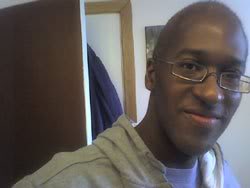 Life has no concern for fairness. That is the job of the living. We all face challenges throughout our journeys on this road. We all face unfairness. It is how we respond to these situations that showcase our humanity. Emru Townsend was given an unfair, and ultimately unbeatable challenge. But he never hid from it. Instead he embraced it, and instead of closing himself off, he opened himself up. His drive and will has taught thousands of people how they can save lives. His kindness and intelligence saved people’s lives. And his deep inner love helped others in their darkest hours.
The name Emru means respect. And he more than lived up to his name, as he respected others and was a man deserving of the highest respect.
Emru was my friend. I was one of those he reached out to, even when his own problems were far worse than mine. For this I can never forget him. For this he will have my eternal respect. For this, he and his wonderful family will always have my love.
Good bye, Emru, and thank you. This world is a better place because you were here.
With respect and love,
Bill
To find out how to join the bone marrow registry in your country, click here.
Been hoaxed by Martin Eisenstadt? Join the Bone Marrow Registry for redemption
November 11, 2008
While I promised myself I’d basically sit out the latest Martin Eisenstadt furor, I find myself irresistibly drawn toward it again. Damn you, Eisenstadt!
The first reason is this - Eisenstadt came out with his “I was the source behind the Sarah Palin smears” post, and everybody and their brother, sister, mom, dad and MSNBC jumped on it like it was the political scoop of the century. Then, quickly afterward, the meme was sent out that Eisenstadt is a hoax, and everyone quickly retracted.
But despite the knowledge that Eisenstadt was a parody, a new meme emerged that shows, dare I say, a profound lack of critical thinking skills:
Carl Cameron of Fox News cited anonymous sources from the McCain Campaign that Sarah Palin wasn’t too bright + Martin Eisenstadt claims to be a McCain Campaign worker and that he was the anonymous source + Martin Eisenstadt is found to be a hoax = Carl Cameron was fooled by Martin Eisenstadt and his anonymous reports are therefore lies!
And it’s not just rabidly pro-Palin folks that are jumping on the illogical train. Jonathon Turley wants answers from Cameron. Digital Journal needs Fox News to address whether “Marty” was the source. And others are echoing this wildly stupid leap of logic.
This is one of the reasons why - after several months of knowing the name “Eisenstadt” in any of its various forms - I have a lot more respect for him, whoever he really is, than I do the vast majority of the media. He’s about the only one showing even a modicum of guile.
There’s another reason I have a soft spot for Eisenstadt, and it leads to how those that were hoaxed by him can pay penance:
It was May 30 when I was officially “suckered” by Eisenstadt myself. I got an e-mail and ran with it, as many have since. Of course, I didn’t have the benefit of Googling him and finding out who he was. Instead, I started researching, and by June 4 had things pretty well figured out. I was hoaxed and admitted such.
I did hours of research on Eisenstadt to come to that conclusion, and I really enjoyed it. For one, I enjoy remembering I’m a journalist. More than that though is this - I was in California at the time with my parents as my Mom fought Leukemia. While I was in California I put together a bone marrow donor drive, I helped my frazzled parents stay informed, and basically just pitched in wherever I could. The Eisenstadt research, mostly done late in the evenings, was a great way to take my mind away from a depressing and frightening reality.
Today, my Mom is recovering very well after receiving a bone marrow transplant from an anonymous 48-year-old donor. That donor, who didn’t know my Mom whatsoever, saved her life.
So here’s the deal - those of you who have been hoaxed, or are passing on the “Cameron was hoaxed” absurdity, you can make it all better, at least in my eyes, by doing one simple thing: Join the National Marrow Donor Program’s Bone Marrow Registry.
The Registry is literally always desperate for donors, and it’s the simplest, easiest way you can do something that could lead to directly saving the life of someone who needs a marrow transplant to survive.
Go to Marrow.org and find out just how easy it is to join the registry. Or if you’re already on the registry, donate something, anything to help them in their quest to get more people signed up.
This is no hoax. The National Marrow Donor Program needs you. So join them and find redemption.
-WKW
Are you in London? Join the Bone Marrow Registry tomorrow
October 17, 2008
Like virtually all other nations on the planet, England needs bone marrow donors to come forward and offer the gift of life to the many in need of a bone marrow transplant to survive. Tomorrow in London there’s a registration drive happening. Here’s the vitals:
Saturday, October 18, 2008
11:00am - 4:30pm
Barclays Bank
126 Station Road HA8 7RY
London, United Kingdom
The event is being held by the African Caribbean Leukemia Trust. From my friend Tamu Townsend:
“It doesn’t take much time to register and requires a teaspoon of blood. That’s it. If you match, you will be guided every step of the way. The ACLT’s current campaign is Heroes Wanted. You don’t have to run into a burning building or have superpowers to be a hero. Just a willingness to help.”
If you’re someone who likes to help people, joining the bone marrow donor registry is one of the easiest ways you can not just help someone, but actually save a life. Finding a bone marrow match is a number’s game. And every registry desperately needs more numbers.
If you’re in the U.S. and want to join the registry, head over to the National Marrow Donor Program at www.marrow.org or send me an e-mail at wkwolfrum(at)gmail(dot)com.
Thanks,
Bill
The healing of Emru
September 9, 2008
About four months ago, I left California after spending time with my Mom, who was undergoing a bone marrow transplant. The day I left, my Mom - who had received the transplant some 30 days earlier - Dad and I made a stop at City of Hope Hospital for one of my Mom’s then-twice-weekly check ups. The trip to the airport and the doctor’s visit were both long drives but on the same path, so combining the two trips was quite beneficial.
While waiting with my Mom and Dad for her appointment, I excused myself to the restroom. Upon leaving the rest room, I ran into my Mom’s doctor, who told me that my Mom’s latest tests had come in - the bone marrow from the donor had grafted perfectly. And my Mom was cancer free. One of the last things I told my Mom before leaving back to Brazil was that her bone marrow transplant had been a stunning success. It was a beautiful moment that I will never forget.
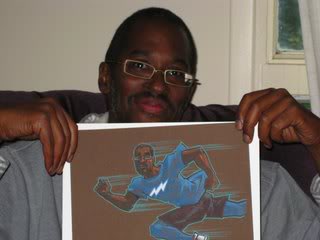
Now, nearly 120 days later, my Mom is living an active life with very minimal side effects from the transplant (minor fatigue, occasional rashes). She and my Father have their life back. It has been nothing short of a miraculous journey. My Mom is an amazing woman.
When something like this happens, you just want to thank everyone who has helped along the way. Literally thousands of people played a role in my Mom’s recovery and I have such gratitude for all of them. But right now, I want to give my deepest, warmest words of gratitude to one man.
Thank you, Emru Townsend. Thank you so much.
Life is good
May 24, 2008
Life is good.
Sitting in my Mom’s room as she peacefully sleeps, more than ever I’m struck with that simple thought. Life is good.
Obviously, the main reason I have that on my mind is due to my Mom’s remarkable progress through her bone marrow transplant. This morning, her white cell count was 4.6. Her platelets have raised to the point that they are now in the normal zone. And to make it even better, after 14 days quarantined in her hospital room, today she was allowed to leave the room and walk around a little bit.
The battle is by no means won, but it is being won. And it was a glorious day, just as yesterday was, and just as tomorrow will be.
Even more than that, however, is the fact that you can’t go through an experience like this without being fundamentally affected. In five months, there has just been so much to appreciate and to find encouragement from. And it has all led to the most basic conclusion.
Life is good.
I think about all those in our lives who have done so much to be a part of my Mom’s fight against leukemia. This has been, and will continue to be a story with many players, with all roles having importance.
I remember a woman named Laura Molina, driving 100 miles to be a part of our bone marrow drive because she had lost someone dear to her and coming to our drive was part of her healing process.
I remember the first time I spoke to Pat Conlee from the National Bone Marrow Program, and that her first instinct was to be a friend.
I remember everyone who showed up at the bone marrow drive, and how the day became one of positivity and of the joy of life.
And the Shakers and other Internet friends, who have given me and my family so much love from all over the globe.
There was the recent day when my parents’ old friends came to visit my Mom, and afterward watching their eyes light up when they discussed their trip to New York City.
Because life is good.
I think of a good man who I’ve never met in person - Emru Townsend - who is also battling leukemia. After three tries to get into remission, he’s still not there. But that hasn’t stopped him and his sister from working tirelessly toward trying to educate people about the bone marrow registry and its importance, especially to those of African heritage. Emru and Tamu have saved lives.
And I think of the amazing and kind people here at the City of Hope, from doctors to nurses to those that clean the floors. They all help in the healing process.
And our long-time friends Stan and Virginia, who have opened their home and hearts to us.
And the squirrel that took a peanut from my hand the other day. And the bunnies in my parent’s backyard. And Max, Jack, Duchess, Afonso and Harry and all the other animals I adore.
I think of my boss and friend Mark, who just today saw his third child come into the world.
And of a 48-year-old man, whose giving spirit is giving my Mom the chance to enjoy her life, her husband, kids, grandkids and great-grandchild for many more years to come.
I think of my family, and how we’ve laughed, cried and grown closer than ever.
And I think of my wife. My beautiful Emilia, who has helped me become a man and who has only offered my Mom encouragement and love and has supported and pushed for me to be at my family’s side even though it has meant 12 weeks away from her.
And, of course, there’s my Mom, who has endured so much and is coming through it all. Again. Death has stared her right in the face, and she has been relentless in her fight to live.
Because life is good.
We are a different breed. We care about our country and want freedom for all. We want equality. And it affects us greatly when we see so much that’s bad with the world. But even when politics, personal lives, war, sexism, homophobia and all the other things we despise get us down or anger us, we should never forget that there is a glorious world out there.
Life is good. It is worth fighting for. And more than that, it is worth living and enjoying. We are all miracles, incredible creatures that have been given the ability to enjoy all the good that life can bring. But as I’ve found, even the bad times can give you strength, perspective and even joy.
We are complicated creatures, we humans. But we have been given the ability to enjoy all the great things that life has to offer. And the greatest of these things is love. And the love we’ve felt from all of you has been immense and overwhelming. And it has proven, without a shadow of a doubt, that life truly is good.
Thank you all, so very much, for being a part of this journey with me.
With love,
Bill
Thank you, 48-year-old Man
May 1, 2008
Dear 48-year-old Man,
I’m writing to you to say thank you. I know nothing about you. Not where you live, not your name, not anything. But you are my hero and someone I’ll always be thankful to. Because you are my Mom’s bone marrow donor and because you are saving the life of a woman you’ve never met and maybe never will.
When we were told my Mom had Acute Myleoid Leukemia, we were told that a bone marrow transplant may be my Mom’s best hope. It seems so scary at the time. Getting chemo to go into remission, finding a matching donor, going through all the tests to find out if my Mom was ready for the procedure.
But now, my Mom is undergoing chemo and radiation treatment in order to prepare for the transplant. She’s at City of Hope Hospital, where she’s staying with my Dad in a bungalow on hospital grounds. Tomorrow, they will go home for a night, even.
My Dad asked the doctor in charge of my Mom’s marrow transplant if he felt confident about the procedure. “We wouldn’t be doing this if I wasn’t confident,” the doctor said. And right now, with my Mom feeling strong and the transplant day soon approaching, we’re all feeling that confidence. This marrow transplant is going to work, and the reward for my Mom will be years of life that she never would have gotten without the transplant.
So, my friend, thank you. Wherever you are and whoever you are, you are my hero. You are a perfect match with my Mom, and it seems you never hesitated when you learned you could save a stranger’s life. And by doing that, you are helping an entire family, their friends and loved ones. You are truly giving the gift of life, and we are all more touched and happy and confident than we imagined we could be. With the date of the transplant still a week away, your gift has already given us so much, and will give us so much more in the very near future.
Thank you, 48-year-old Man. Thank you so, so much.
Bill Wolfrum and Family
[If anyone wants to join the bone marrow donor registry or would like to find out how to help people in desperate need of a bone marrow transplant, please click here.]
African-Americans are dying for bone marrow donors - a call to action
April 16, 2008
When I recovered from the shock of learning that my Mom had acute myeloid Leukemia, I set to work on learning more about it, and trying to find what part I could play.
It was evident early on that my Mom would need a bone marrow transplant to survive more than one or two years. AML is a vicious disease that can only be repressed by intense chemotherapy. It comes back, and the chemo treatments quickly lose potency. So I saw the part I would play, and knew it would be a lifetime endeavor.
With the help of Pat Conlee of the National Marrow Donor Program, I began to learn about the bone marrow registry. I worked with Conlee, my Father and friends and family to put together a bone marrow drive for my mother in Victorville, Calif. But I knew that was not to be a one-time effort, and that the NMDP needed help from wherever it could find it.
As I learned about the NMDP, one fact struck me extremely hard. For Caucasians in need of a bone marrow transplant, 88 percent find a suitable donor. For African-Americans, that number tumbles to 60 percent.
While any person of any race can be a suitable person for anyone in need, the simple fact is this: ethnicity matters when it comes to bone marrow. A Caucasian person has a much better chance of getting a match from another Caucasian. An Asian person has a much better chance of being matched with another Asian. An African-American has a better chance of being matched with another of African descent.
According to the NMDP, there are just 11 million people on the bone marrow donor registry. And that’s not in the U.S. That’s in the world. In the U.S., there are five million white people on the registry. There are 500,000 blacks. There lies the difference between the 88 percent and 60 percent figures.
This is a call to the black community. The National Marrow Donor Program needs you. And those of African descent need you even more. They are literally dying for a better representation of blacks on the bone marrow registry.
To put a face to issue, let me point to my friend Emru Townsend. In December, Townsend - of Montreal - was told that he had AML, as well as a disorder called monosomy 7. He was told he needed a bone marrow transplant to survive. He was also told that due to his African-Caribbean heritage, his chances of finding a donor were much less than if he were white.
But Townsend did not waste his time with self-pity. He immediately began to champion the cause, and his efforts to get more blacks on Canada’s bone marrow registry have been covered in newspapers, radio and on television. He is a true inspiration, going so far as spending days working to get his message out while he is receiving chemotherapy. And he is still without a matching donor. His site - HealEmru.com - tells his story and has valuable information on how one can get on the bone marrow registry.
“After everything I’ve learned, I just can’t believe that everyone is not on the registry,” said Townsend. “It’s just such an easy thing and it’s so important to so many families.”
In the U.S., one of the reasons for the lack of donors of all races is likely the cost. It costs $52 to get on the registry, but that amount falls to $25 for African-Americans due to the need. But even if an African-American doesn’t have a dime to spare, if they want to get on the registry, they will not be turned away. But this is why donations are always eagerly accepted by the NMDP to help defray the costs of the tissue typing necessary.
The process for donating is simple - all it takes is a few swaps from a person’s inner cheek, filling out some paperwork, and it’s done. If you are called as a potential match, you will be given a battery of tests (free of charge) that will see if you are in good health and able to donate. The donating process consists of taking some marrow from your spine (under local anesthesia) and does not entail an overnight stay in a hospital. Generally, some minor discomfort for a day or two is the full price that has to be paid for saving a life.
For my allies in the POC blogosphere, and anyone else interested in helping, I humbly request that you write about this issue in any way you deem fit. Discuss your thoughts on why blacks are so underrepresented if you like. Discuss the issue from any angle you wish. But please discuss it. And register. And try to get more people of African descent onto the registry. Lives are literally in the balance.
Helpful Links
- The National Marrow Donor Program: Here you will find a plethora of information on the bone marrow registry, including how and where you can register. They can also be reached at 1(800) 627-7692.
- Jes Us For Jackie: Rapper Nelly’s ongoing effort to get African-Americans involved in the bone marrow donor registry. Nelly’s sister died from Leukemia, unable to find a donor.
- Emru Townsend’s site: Townsend has worked tirelessly to create a site that has information on his plight, as well as information on bone marrow drives throughout the U.S. and Canada.
- The Caitlin Raymond International Registry: An International bone marrow and cord blood search and donor recruitment center.
- African-American Community Health Advisory Committee: More information on the need for African-American marrow donors and information on how the process takes place.
- Asians for Miracle Matches: Non-Japanese Asians, Native Americans, and Pacific Islanders are also underrepresented on the marrow donor registry. A3M is trying to change that.
If you have any other questions, such as how to put together a bone marrow drive in your community or anything else, feel free to contact me at wkwolfrum(at)gmail(dot)com.
-WKW
Be a bone marrow donor, it’s an easy way to save a life
March 28, 2008
My Mom woke up the other night at 3 a.m. Which meant my Dad was awoken by her at 3:15 a.m. She was worried about the upcoming bone marrow drive. Would we have enough seats? Were we prepared? Was everything going to run smoothly?
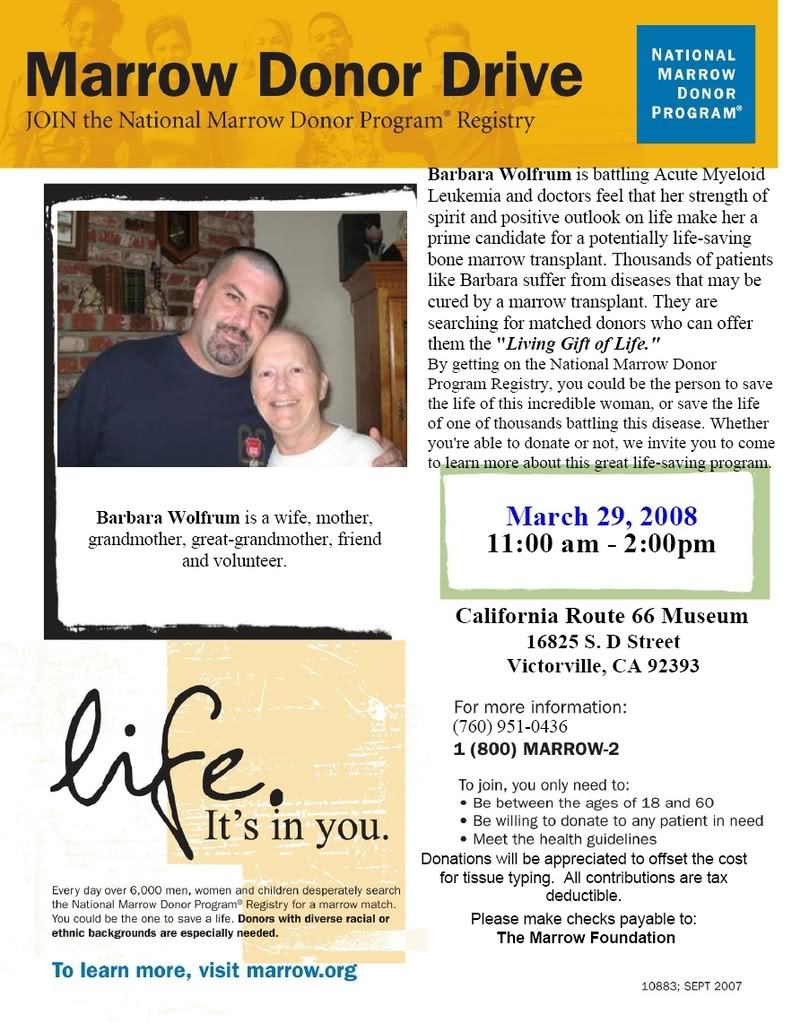 My Dad asked her why she was worrying about it when the only responsibility she was given for the drive was to be there. She was just worried, she said, and ended up falling back to sleep at around 4 a.m.
So it’s good to see my Mom is really back to her old self. Because that’s what she does. She worries. To say she was a control freak would be just a slight understatement. But such is her way, and that she’s looking for things to control means she must be feeling well.
The Bone Marrow Donor Drive is tomorrow, and is sponsored by the National Marrow Donor Program. It’s been a moderate amount of work to put together at worst. It really hasn’t been a chore, especially because it was easy to get a place to host it - that place being the California Route 66 Museum.
We’re hoping to get a lot of people registered, but we’re being realistic. Whatever happens happens and won’t be due to a lack of effort. We got the word out for this event.
But I’ll be spending the rest of my life getting the word out that people need to get on the Bone Marrow Donor Registry.
Yesterday I spoke with Emru Townsend, who suffers from the same type of leukemia as my Mom but with a couple bonus ailments, and he said something that really hit home.
“Were you like me when you found out about this?” he asked. “Were you just wondering why everybody hasn’t signed up to be a donor?”
And it’s true. It requires very little. While there is a normal fee of $52 for tissue typing, that fee can usually be worked around. By working with the National Marrow Donor Program, I got our fee knocked down to $20. Plus minorities are free. Plus if you don’t have $20 to spare, you can still sign up.
To get on the registry requires just a painless swab from the inner cheek. To be a donor requires a minor procedure that is akin to getting a cavity filled. Assuming the cavity was located in your lower back, of course. There are potential complications. But there are potential complications in crossing the street, and lots of people seem willing to do that every day.
So hopefully tomorrow will be a glorious day where hundreds of people register and my Mom’s perfect match will be found. But even if not, the word is getting out a little more and there will be a few more people on the registry.
There are thousands of people looking for the perfect match so they can receive a bone marrow transplant to live. My Mom is just one of those people, as is Emru Townsend. But there are thousands out there, and your bone marrow may be what they need to live.
So please, wherever you are, join the bone marrow donor registry. You may give someone the gift of life. And pass the word along. Thanks.
Bill
